Native spike-sorting curation
Spike curation, in full view.
Waveforms, features and timing, linked in one workspace. Inspect the evidence. Merge, split and label with confidence.
phy · Kilosort · SpikeInterface · NWB (trunk)

One selection. Every view.
Brush a group of spikes and follow it through waveforms, feature space and time. The evidence stays connected while you decide what belongs together.
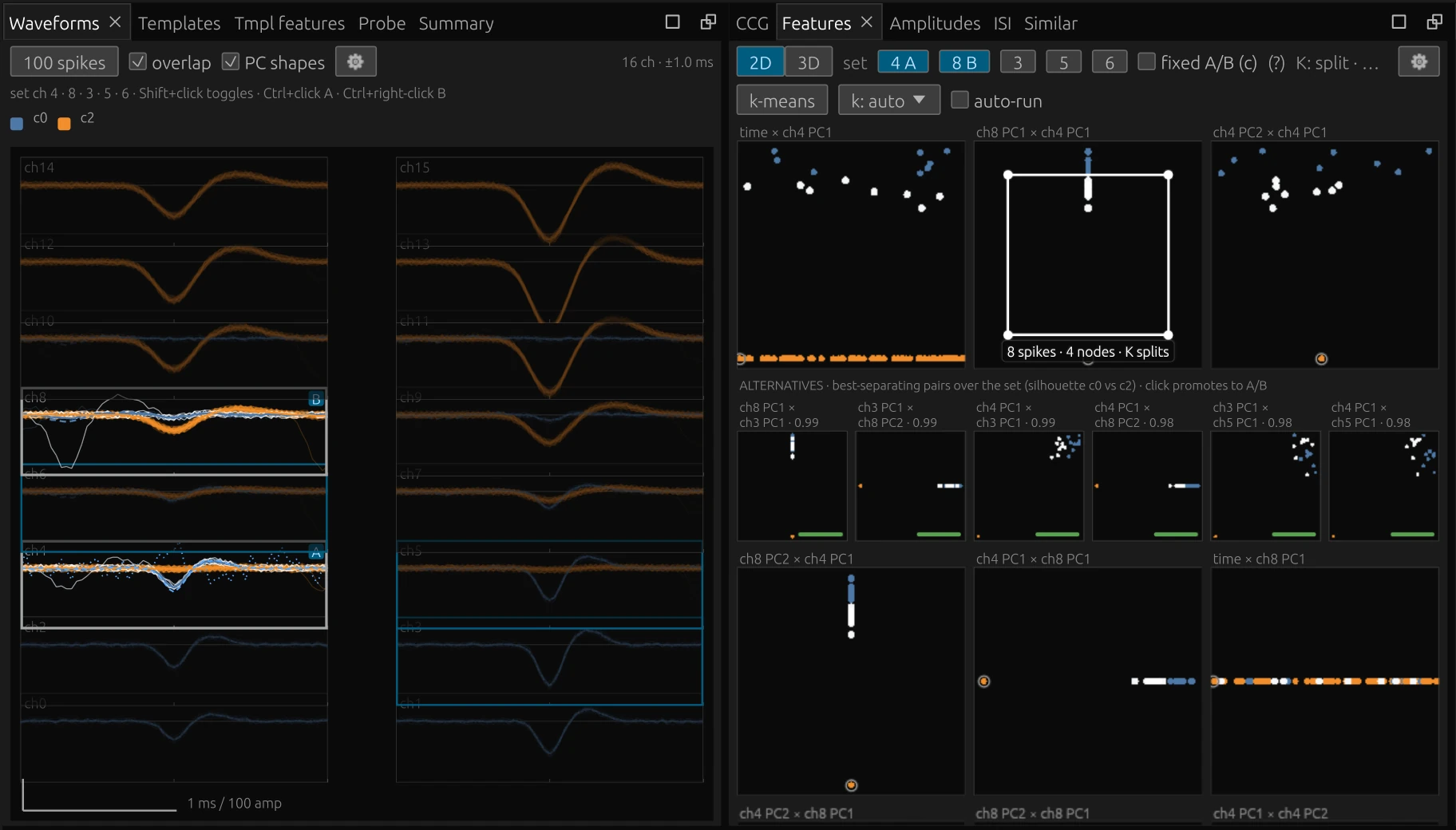 View linked selections
Look closer. Make the call.
Explore the tools behind a curation decision. These are Sorrel's own UI-test states, composed in OpenPencil—not mock interfaces. Select any image to enlarge it.
Built for curation work
Linked views, one decision
Trace, raster, ISI, CCG, waveform, template, feature, drift, probe, similarity and quality views share a selection, so every merge, split and label is checked against the same spikes.
Review agent proposals
Agents connect over MCP and can propose relabels, merges and splits with confidence and reasons. In Direct mode their edits are journaled and undoable; in Propose mode nothing changes until you accept.
A journal that keeps every edit
Every edit from you, an agent or an algorithm lands in a branching journal before the session moves. Undo walks back; editing after undo branches instead of discarding. The tree survives save and reopen.
Optional GPU trace processing
wgpu kernels for common-median referencing, high-pass filtering and mean-snippet extraction share the renderer's device and queue. Without a GPU adapter, the trace path falls back to the CPU implementations; headless QC uses them directly.
Headless QC export
sorrel qc DIR --out DIR runs firing rate, presence, refractory contamination, amplitude stats, ISI violations, isolation distance where PC features exist, and composite quality, writing cluster_qc.tsv and cluster_qc.json without a window.
Python bridge
sorrel.open(recording, sorting) builds a SortingAnalyzer and launches the native GUI; sorrel.Session.open("my_run/phy") edits the same journal from a notebook, with the same save and undo history.
Reads what you already have
Point sorrel open at the sorting directory you already have; it detects the backend from the files inside.
phy / Kilosort spike_times.npy · spike_clusters.npy · params.py
A directory of spike_times.npy, spike_clusters.npy and params.py, plus optional templates, PC features, amplitudes, channel_positions, similar_templates and quality-metric sidecars — read exactly as phy does.
SpikeInterface SortingAnalyzer · binary_folder
A SortingAnalyzer saved as binary_folder: recording.json, the flat sorting under sorting/, an optional probe.json, and the quality_metrics extension.
NWB & legacy MATLAB rez *.nwb · rez.mat
*.nwb via /units/spike_times and the electrodes table; MATLAB v7.3 rez.mat from Kilosort 2, 2.5, and 3 via rez/st3 and rez/ops. Both readers are enabled by default on trunk, but not in the stable 0.4.0 binaries. Open Kilosort 4 results as a Phy directory.
Raw recording sources SpikeGLX · Open Ephys · MDA
SpikeGLX .bin + .meta, Open Ephys continuous.dat + structure.oebin, and Mountainsort MDA plug in via --dat, --spikeglx-meta and --oebin.
Install
Download the native build for your OS. Then point Sorrel at a sorting directory and it detects the backend.
Open full install guidepip install sorrel-ephyscargo build --release -p sorrel